Offer

According to Professor Treitel
"An offer is an expression of willingness to contract on specified terms, made with the intention that it shall become binding as soon as it is accepted by the person to whom it is addressed."
A distinction must be made between offer and invitation to treat. An invitation to treat is insufficient for the creation of a contract.

How to determine offer and invitation to treat? It depends on the intention of the parties. For there to be a valid offer, the offeror must reveal his or her intention to contract with the offeree, allowing no room for negotiation. An offer contains final and conclusive terms, thus a discussion on the term of the contract is an invitation to treat.
  • In Gibson v Manchester City Council (1979), the question posted to the House of Lords was whether the Council’s letter constituted a valid offer. In the Council’s letter, it was mentioned that, '... refer to your request for details of the cost of buying your Council house. The Corporation may be prepared to sell the house to you at the purchase price of £2,180…” The House of Lords held that the council’s letter was not an offer. The words “may be prepared to sell” were not strong enough to constitute an offer. A valid contract only exists when there is a clear offer mirrored by a clear acceptance. In other words, a valid offer shall express the offeror’s intention to create a legally binding contract, and a contract would thereby be concluded if the offeree replied ‘yes’.
  • In Storer v Manchester City Council (1974), the Council sent the plaintiff a document titled ‘Agreement of Sale’ and a letter which stated, “If you will sign the Agreement and return it, I will send you the Agreement signed on behalf of the council in exchange.” Plaintiff signed and returned the ‘Agreement of Sale’. Subsequently the Labour party took control of the council and did not return a signed copy and refused to sell the property. Plaintiff sued for breach of contract. The Court of Appeal found that there was a binding contract. The council had sent the plaintiff a clean and certain communication, that they intended would, be binding upon his acceptance. All the plaintiff had to do to bind himself to the later was sign the document and return it.

Invitation to treat & Mere inquiry for more information


A mere inquiry for more information, for example asking for the best price, is an invitation to treat.
  • In Harvey v Facey (1893), Harvey sent a Telegram to Facey which stated, "Will you sell us Bumper Hall Pen? Telegraph lowest cash price-answer paid." Facey replied by telegram, "Lowest price for Bumper Hall Pen £900." Harvey then replied, "We agree to buy Bumper Hall Pen for the sum of nine hundred pounds asked by you. Please send us your title deed in order that we may get early possession." The Privy Council held that that there was no contract concluded between the parties. Facey had not directly answered the first question as to whether they would sell and the lowest price stated was merely responding to a request for information not an offer.


Even though the term “offer” has been used, it is not necessarily that it is a valid offer. As I mentioned above, an offer shall reveal the offeror’s intention to create a legally binding contract, and a valid contract would thereby be concluded if the offeree replied ‘yes’.
  • In Clifton v Palumbo (1944), the plaintiff and the defendant were negotiating for the sale of an estate. The plaintiff wrote to the defendant, “I… am prepared to offer you… my Lytham estate for £600,000… I also agree that a reasonable and sufficient time shall be granted to you for the examination and consideration of all the data and detail necessary to you for the preparation of the Schedule of Completion.” The Court of Appeal held that this statement is not an offer. Contract involving real property should not containing ‘phrase and expressions of doubtful significance’, the words “I am prepared to offer” showed that the plaintiff has no certainty of intention, despite the expression “offer” has been used by the marker of the statement.
  • In Bigg v Boyd Gibbins (1971), the defendant wrote to the plaintiff, “I offer £20,000 to buy your house.” The plaintiff replied, “Your offer of £20,000 would appear to be least a little optimistic. For a quick sale, I would accept £26,000.” The defendant accepted. Subsequently the defendant regretted his decision and did not want to sell his house anymore. It was held that there was a binding contract formed. The word “for a quick sale” indicates urgency to conclude the contract. It could be safety inferred that the defendant had intended to be legally bound once it is accepted and does not want to negotiate any longer.

---------------------- THE WALLY EFFECT http://thewallyeffect.blogspot.com/ ----------------------


Battle of the forms – The ‘last shot’ doctrine

In some cases the parties will attempt to contract on (differing) standard forms. In such instance, there will be ‘battle of forms’ with offers and counter-offers passing to and fro. In theory the party who has the ‘last shot’ will wins the ‘battle of forms’: Butler Machine Tool Co Ltd v Ex-Cell-O Corporation (England) Ltd (1977)

In Tekdata Interconnections Ltd v Amphenol Ltd (2009), the Court of Appeal considered the question of whether there could be circumstances in which a traditional offer and acceptance analysis could be displaced by reference to the conduct of the parties over a long-term relationship. The court rejected the question and confirmed that the ‘last shot’ prevailed unless there was a clear course of dealing between the parties. The parties who which to maintain long term relationship should take great care to negotiate whose terms are to apply to a given commercial transaction. This reason was of both desirable and necessary in order to promote effective commercial relationships.

Display of Goods


A display of goods in the shop is an invitation to treat. An offer is made when the customer takes the goods to the cashier. The cashier then accepts the offer.
  • In Pharmaceutical Society of Great Britain v Boots Cash Chemist (1953), Boots Cash Chemists had just instituted a new method for its customers to buy certain medicines. The company would let shoppers pick drugs off the shelves in the chemist and then pay for them at the till. Before then, all medicines were stored behind a counter and an assistant had to get what was requested. The Pharmaceutical Society of Great Britain objected and argued that under the Pharmacy and Poisons Act 1933, that was an unlawful practice. Under section 18(1), a pharmacist needed to supervise at the point where "the sale is effected" when the product was one listed on the 1933 Act's schedule of poisons. It was held that the goods on the shelf constitute an invitation of treat and not an offer.
  • In Fisher v Bell (1961), the defendant had a flick knife displayed in his shop window with a price tag on it. Statute made it a criminal offence to 'offer' such flick knives for sale. His conviction was quashed as goods on display in shops are not 'offers' in the technical sense but an invitation to treat.
In Grainger v Son and Gough (1896), Lord Hershell commented that (obiter dictum) price-list would not be considered as an offer, if the supplier could not fulfill the orders. On the contrary, the price-list could amount to an offer, if they are specified price, specified description and its supply to specific people. Of cause, the supplier must have the ability to make loads as soon as possible.

Advertisement

A distinction must be made between bilateral advertisement and unilateral advertisement.

In Partridge v Crittenden, the defendant placed an advert which stated “Bramble finch cocks and hens, 25s each.” He was charged under the provisions of the Protection of Birds Act 1954 for unlawfully offering for selling wild life bird.  His conviction was quashed. The advertisement was held to be an invitation to treat and not an offer for sale. Lord Parker CJ expands the obiter dictum of Grainger v Son and Gough (1896) and suggest that, if the seller is the manufacturer , then perhaps this justification for the rule does not apply (as manufacturer could potentially make loads).


In Carlill v Carbolic Smoke Ball Company (1892), the Carbolic Smoke Ball Company published advertisements, claiming that it would pay £100 to anyone who caught influenza after using its product according to the instructions. A newspaper advert placed by Carbolic Smoke Ball Company stated: “£100 reward will be paid by the Carbolic Smoke Ball Company to any person who contracts the influenza after having used the ball three times daily for two weeks according to the printed directions supplied with each ball… £1000 is deposited with the Alliance Bank, shewing our sincerity in the matter.” Mrs. Carlill raised the following arguments to demonstrate the advertisement was a mere invitation to treat rather than an offer. The Court of Appeal held that Mrs. Carlill was entitled to the reward for the following reasons:
  • The advertisement was not a mere puff because the act that they deposited £1000 in the Alliance Bank was proof of their sincerity to pay.
  • A promise is binding even if it was not made to anyone in particular. This unilateral offer has been made to the whole world and will ripen into a contract with anybody who comes forward and performs the conditions. In unilateral contracts, there is no requirement that offeree communicates an intention to accept, since the acceptance is through full performance.
  • There was consideration in this case for two reasons. Firstly, Carbolic Smoke Ball Company received a benefit through the sales made by their advertisement. Secondly, the people using the smoke ball according to the directions as indicated by the company have suffered inconvenience and detriment. Performance of the specified constitutes consideration for the promise.
  • The defendant argued that the terms are too vague to constitute an offer since there was no stated time limit, as to catching the flu. A person might claim they contracted influenza 10 years after using the smoke ball. This argument has failed because if you use the remedy for two weeks, you shall not be contact the flu within a reasonable time after that. 

Auction


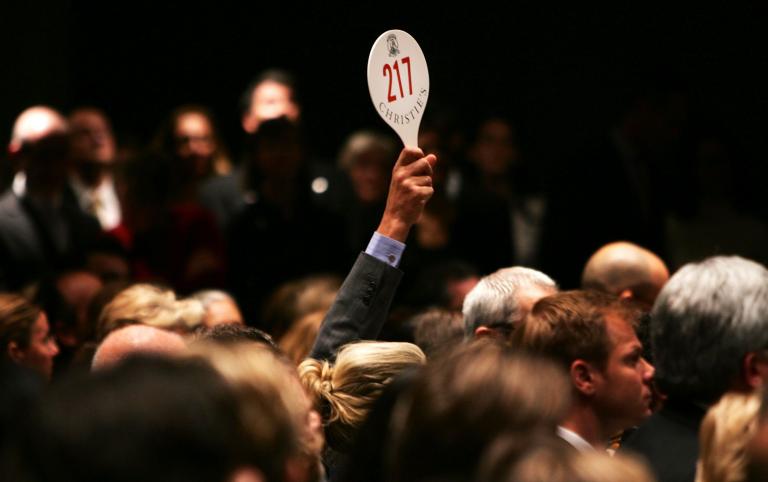
In an auction, the bid made by the bidder is the offer, acceptance takes place when then auctioneer signifies his acceptance by the customary fall of the hammer.
  • In Payne v Cave (1789), in an auction of a worm tub, the defendant bided £40. He then asked the auctioneer if it was worth that price, to which he received a negative answer. The defendant then changed his mind and withdrew his bid before the auctioneer bought down his hammer. The tub was auctioned off the next day to D for £30. P tried to recover the difference. It was held that the contract is formed at the end of the auction, when the hammer strikes.
An advertisement for an auction is an invitation to treat.
  • In Harris v Nickerson (1873), Nickerson advertised in the London newspapers that a public auction of certain goods and office fittings would take place in Bury St Edmunds on 14 August 1872. On the faith of the advertisement Harris attended the auction and 'was ready to purchase in pursuance of such request and public notification' but Nickerson 'suddenly and without notice withdrew the goods and office fittings from the sale'. Harris sued for £2 16s 6d (two days' lost time, railway fare and two days' board and lodging). It was held that an advertisement for an auction is merely an invitation to treat.


In McManus v Fortescue (1907), it was held that if goods are put for sale “with a reserve price” and the auctioneer accepts a bid that is lower than the reserve price, then there is no contract has been formed.

The auctioneer is bound to accept the highest bidder’s offer.
  • In Warlow v Harrison (1895) the defendant, who was an auctioneer, advertised that ‘The three following horses, the property of a gentlemen, without reserve.’ P attended the auction and bid 60G. The owner of the house, Mr. Henderson attended the auction too and bid 61G. The plaintiff knew that it was the house owner who bid 61G, so he did not bother bidding any higher. The defendant knocked down the hammer 3 times to the horse owner.
  • The courts has now accepted the obiter dicta of Martin B in this case in the future case, in which it was stated that the auctioneer is liable personally to the highest bidder under a separate and distinct contract. There is an implied undertaking to accept the highest bid. This means that an offer is made by the auctioneer that the sale will be without reserve. The highest bidder than accepts this offer.

Tenders


An advertisement to tender is an invitation to treat. An offer is made when the offeror submit the tender, and it is up to the offeree to accept or refuse the offer. Unlike auction, there is no legal obligation to accept the highest tender.    
  • In Spencer v Harding (1870), the defendant advertised, 'We are instructed to offer to the wholesale trade for sale by tender’. The advertisement specified where the goods could be viewed, the time of opening for tenders and that the goods must be paid for in cash. No reserve was stated. The plaintiff has submitted the highest tender but the defendant refused to sell to him. The advertisement was held to be an invitation to treat, the tender was an offer, and the defendant could choose whether to accept the offer or not. There was no obligation to sell to the person submitting the highest tender unless the advertisement specifies that the highest tender would be accepted.


A referential bid is not a valid offer.
  • In Harvela Investments Ltd v Royal Trust of Canada (1896), the Royal Trust of Canada owned shares in a company, and invited bids for them. Harvela bid $2,175,000 and Sir Leonard Outerbridge bid "$2,100,000 or $101,000 in excess of any other offer… expressed as a fixed monetary amount, whichever is higher." The Royal Trust accepted Sir Leonard's bid as being $2,276,000. Harvela sued for breach of contract, saying a referential bid was invalid. The House of Lords held that the referential bid were invalid, so that the only bid was Harvela and Royal Trust of Canada was bound to accept it. It must be noted that before the bid began, Royal Trust of Canada telexed Harvela and Sir Leonard Outerbridge inviting tenders and stating, ‘We confirm that if the offer made by you is the highest offer received by us we bind ourselves to accept  such offer providing that such offer complies with the terms of this telex.’ Royal Trust of Canada’s specification that it binds itself to accept the highest bid meant that the invitation to submit tenders amounted to an offer. By submitting the highest bid, Harvela accepted the offer and a unilateral offer was formed. By the way, Sir Leonard Outerbridge’s referential bid was deemed invalid because the specification of the intention, to submit tenders implied no referential bids.


There is an obligation to consider all tenders.
  • In Blackpool & Fylde Aero Club v Blackpool Borough Council (1990), the defendant has invited tenders to operate flights. It was submitted that the tenders had to be submitted no later than noon on 17 March 1983. The plaintiff posted tender in Town Hall letter box at 11am on 17 March 1983, letter box was due to be collected at noon but in fact it was not. The defendant did not consider the plaintiff's tender because it was wrongly recorded as a late submission. The Court of Appeal held that the council’s invitation to tender was a unilateral offer to consider all tenders which fell within its rules. The tender constituted an offer which had been accepted by the Aero Club. The offer was accepted by any party who put in a tender. Thus the council was obliged to consider all tenders, including the Aero Club tender’s. However there is no legal obligation to accept any particular tender. 

---------------------- THE WALLY EFFECT http://thewallyeffect.blogspot.com/ ----------------------


Communication of the offer

An offer must be communicated to the offeree to be capable of acceptance.
  • In R v Clarke (1927), the plaintiff wanted to compel the Crown to pay a reward it had offered for information leading to the conviction of a murderer. It was submitted that he was “first decided to claim the award a few days after the appeal had been dealt with” and “gave no consideration and no intention with regard to the reward.” The Crown held that no contract was formed between him and the Crown. It was uncertain whether the claimant was thinking about the reward at the time he provided the information.
  • In Gibbons v Proctor (1891), a police officer supplied the information for which a reward had been offered. He was unaware of the offer at the time that he gave the information but he had become aware of the offer by the time the information was relayed to the police. It was held that the police officer was entitled to claim the reward.


In Tinn v Hoffman (1873), there were negotiations as to the quality and price of iron, letters crossed in the past. The plaintiff wrote to the defendant asking for a price on 800 tons of iron. The defendant has offered the iron at 69s per ton and asked for a reply “by return”. It was conceded that since the offer was not at in fact accepted by return of post, there was no contract but Honeyman J said (obiter dicta) that a telegram or verbal massage or other means at least as a letter written by return of post would have been sufficient. Further, there would be no contract if letters cross in the post because there is no identifiable offer and acceptance. Cross-offer doesn’t constituted acceptance.

In Williams v Carwardine (1833), the plaintiff knew of the offer of a reward in exchange for information, but her motive was to salve her conscience and she was in hopes of forgiveness. It was held that she was entitled to recover the award since she had clearly performed the terms of the offer (giving information that lead to the conviction of the murderer) and handbill, which she must have been known of given that is was posted and promised to give money for that information. As a result, a contract was formed with any person who performed the condition, without considering the motivations of the individual.

Termination of an offer

An offer could be terminated in certain circumstances.  


Termination of an offer - Revocation of an offer

According to Offord v Davies (1862), an offer can be revoked or terminated by the offeror at any time before it has been accepted. It must be done before the communication of acceptance. There is no legal commitment until a contract has been formed, either party may change their mind and withdraw from negotiations.

In Byrne & Co v Leon Van Tienhoven & Co (1880), the defendant posted a letter on 1 October, to the plaintiff offering to sell 1000 boxes of timplates. This offer was only received by P on 11 October, who sent an acceptance immediately. The defendant sent a letter on 8 October to revoke his offer. The letter containing the revocation reached the plaintiff on 20 October. It was held that there was a binding contract and the revocation is ineffective. It only took effect on 20 October in which, by the time, a contract had already been concluded. It should be noted that postal rule does not apply to revocation of offer.

An offer cannot be revoked once it is accepted: Great Northern Railway v Witham (1873)

In Dickinson v Dodds (1876), the defendant on 10 June offered to sell to the plaintiff a house for £800. It was further provided in the offer letter that the offer is to be left open until Friday. However, on Thursday, the defendant sold the house to a third party and the plaintiff was told of this sale by another third party. The plaintiff sent an acceptance to the defendant on Friday. It was held that communication of the withdrawal of the offer can be made by any reliable third party.
It shall be noted that the principle is not to be applied too mechanically. It has been suggested that whether the communication of a revocation of an offer by a third party is effective or not depends on the reliability of the information relayed by the third party. Therefore, regard must be had of the credibility of the third party informer.

For revocation of unilateral offer, English law provides no answer to this question.
  • In the American case Shuey v United States (1875), it was stated that to revoke a unilateral offer, it must be done in the same or better way as the declaration of the offer. It was suggested to use the same or better mode of communication to revoke and target the same group of renders of the offer.
  • But this does not apply in unilateral offers where acceptance requires full performance. In the case of Errington v Errington and Wood (1952), the Court of Appeal held that the personal representatives of the offeror could not revoke the offer, as the offeree had started upon the performance of the act, and that provided that they had not left the performance “incomplete and unperformed”, the revocation of the offer was not possible.

Termination of an offer - Counter-offer

If the offeree rejects an offer or made a counter-offer, the original offer is terminated: Hyde v Wrench (1840)

Termination of an offer - Unfulfilled condition

Where the offer is made subject to a condition which is not fulfilled, the offer terminates. The condition may be implied.

In Financings Ltd v Stimson (1962), the offeror purported to accept an offer to purchase a car after the car had been badly damaged. An offer will lapse where it is made on an unfulfilled condition.

Termination of an offer - Death

In Bradbury v Morgan (1862), it was held that the deceased offeror’s estate was liable on the offer of a guarantee after the death of the offeror. Channel B commented that, “In this case of a contract death does not in general operate as revocation, but only in exceptional cases, and this is not within them.”

However in Dickinson v Dodds (1876), it was mentioned that (obiter dicta) the death of either party terminated the offer because there could no agreement.

Professor Ewan McKendrick suggested that an offeree cannot accept an offer once he knows that the offeror has died but that his acceptance may be valid if it is made in ignorance of the fact that the offeror has died, provided that the contract is not one fir the performance of personal services.

There is no authority on the position where it is the offeree who dies. The generally accepted view is that on the offeree’s death, the offer comes to an end by operation of law.

Termination of an offer - Lapse of time


The offeror may set a time limit for acceptance; once this time has passed the offer lapses. In Offord v Davies (1862), the offeror was held entitled to revoke the offer before the time limit lapses provided that the offer has not been accepted.

In Ramsgate Victoria Hotel v Montefoire (1866), an offer will terminate after a reasonable lapse of time. What amounts to a reasonable period will depend on the circumstances.


---------------------- THE WALLY EFFECT http://thewallyeffect.blogspot.com/ ----------------------

Please read the disclaimer (at the top of the page) before proceeding.

Please do not take this note as the sole and only sources to study. It is only a guidance which may assist you in drawing out the full picture of the particular area of law. It is never meant to be a comprehensive text.

Feel free to comment if you find any mistakes, or if you have anything to share. 

COPYRIGHTS © 2017 WALLACE LEE CHING YANG. ALL RIGHTS RESERVED.

The recognition and enforcement of foreign judgment

A foreign judgment has no direct operation in England. They may be recognised and enforced in England only if the specific requirements are met.

There are parallel systems in relations to the recognition and enforcement of foreign judgment, in particular the common law principles (traditional rules) and Brussels Regulation Recast.

Brussels Regulation (recast) No. 1215/2012 (BRR) applies only to legal proceedings instituted on or after 10 January 2015: Article 66(1)

Brussels Regulation No. 44/2001 will continue to apply to judgments given in proceedings instituted before 10 January 2015: Article 66(2)


You can download Civil Jurisdiction and Judgments Act 1982 here: http://www.legislation.gov.uk/ukpga/1982/27/pdfs/ukpga_19820027_en.pdf


---------------------- THE WALLY EFFECT http://thewallyeffect.blogspot.com/ ----------------------

Recognition and enforcement of judgments under the Traditional Rule


There are several conditions for a foreign judgment to be enforced in England:
  1. The foreign court must have been a court of competent jurisdiction
  2. The judgment must be final and conclusive
  3. The judgment must for a fixed sum of money

Traditional Rule – The foreign court must have been a court of competent jurisdiction

The court will be one of competent jurisdiction where it has exercised jurisdiction on one of the bases of jurisdiction recognised as acceptable according to English rules of private international law.


The question is not whether the foreign court was entitled to assume jurisdiction according the foreign law, but whether the foreign court had jurisdiction according to English private international law.

The decided cases indicate that there are two situations in which the foreign court will be regarded as a court of competent jurisdiction:
  • Firstly, where the judgment-debtor (person against whom a court judgment has been made, and who is therefore now obliged to pay money that he or she owes) submitted to the jurisdiction of the foreign country;
  • Secondly, where there is a sufficient territorial connection between the judgment-debtor and the country of origin.


A foreign court has jurisdiction over a person who submits to the jurisdiction of it. Submission can take of one of the following three forms: Emanuel v Symon (1908)

Firstly, the foreign court will be regarded as a court of competent jurisdiction if the judgment-debtor consented to the jurisdiction of the forum in which the judgment was obtained: Feyerick v Hubbard (1902)

Consent can take form of a contractual clause providing for the exclusive or non-exclusive jurisdiction of the court. In Copin v Adamson (1875), a domiciled Englishman had submitted to jurisdiction of French court, by taking shares in a French company whose articles of association provided that disputes arising during liquidation should be submitted to a French court. It was held that a judgment from French court could be enforced against him in England.

The consent cannot be implied into the contract, as Scott J in Adams v Cape Industries (1990) stressed that the minimum requirement is that there must be ‘a clear indication of consent to the exercise by the foreign court of jurisdiction’.

Secondly, a defendant who voluntarily participates in the foreign proceedings submits to the jurisdiction of the foreign court. A foreign judgment can be enforced if the judgment-debtor entered an appearance to defend the case, or took any step designed to challenge the merits of the claim or filed an appeal against the judgment to a higher court in the country of origin, not previously having taken any steps in the action: SA Consortium General Textiles v Sun and Sand Agencies Ltd (1978)

If the defendant submits to proceedings brought by P1 in a foreign country this is not to be regarded as an implied submission to related proceedings commenced by P2 in the same court, even if the proceedings commenced by P1 and P2 involve almost identical issues: Adams v Industries plc (1990)

An appearance to the court to protest that a foreign court does not have jurisdiction/ ask the court to dismiss or stay the proceedings on the ground that the dispute in question should be submitted to arbitration of the courts of another country/ or to pretest, or obtain the release of, property seized or threatened with seizure in the proceedings do not give rise to an effective submission: section 33(1) of the Civil and Jurisdiction and Judgments Act 1982

The defendant will not be held to have submitted to the jurisdiction of the foreign court if his appearance in the original proceedings was not voluntary. The question of voluntariness is to be determined by English law: Desert Sun Loan Corp v Hill (1996).

An appearance is not voluntary if it is due to duress or undue influence brought to bear by the other party: Israel Discount Bank of New York v Hadjipateras (1994)

A person who is sued in a foreign country whose exercise exclusive jurisdiction ‘to protect, or obtain the release of, property seized or threatened with seizure in the proceedings’ will not be regarded as having submitted to the jurisdiction of the foreign court: section 33(1)(c) Civil Jurisdiction and Judgments Act 1982).

Thirdly, the judgment-debtor will be held to have submitted to the jurisdiction of a foreign court if he took part in the proceedings as plaintiff: Emanuel v Symon (1908). If, for example, P brings an action for breach of contract against D in New York and the New York court gives a judgment in D’s favour and orders P to pay D’s costs, the order for costs would be enforceable in England on the ground that P had submitted to the jurisdiction of the original court.

It is well established that a foreign judgment is enforceable in England if there was sufficient territorial connection between the defendant and the country of origin. There are three types of situation may give rise to the principle.
  • Firstly, where the defendant is not only resident in the country of origin but also is present there when the proceedings are commenced: Adams v Industries plc (1990)
  • Secondly, where the defendant is present in the country of origin at the commencement of proceeding, but is not resident in that country: Carrick v Hancock (1895) and Adams v Industries plc (1990)
  • Thirdly, where the defendant is resident in the country of origin at the commencement of proceedings, but is not present there at the time. The CoA in Adams v Industries plc (1990) expressly left open this third situation. If presence is properly regarded as a sufficient connection, residence – even if not accompanied by presence – should also be adequate since residence is a more substantial connection than mere presence.


According to Adams v Industries plc (1990), a foreign court may have jurisdiction over companies if
  • It has fixed place of business from which it has carried on its own business for more than a minimal time, and
  • The business is transacted from that fixed place of business.


It was suggested that the above rule is easily established where there is a branch office; it is more difficult where the business is conducted by a representative, an agent or an employee. In such situations where there was indirect presence of the companies through a representative, for examples agent or subsidiaries, the companies would be liable only if the court are convinced to lift the corporate veil.

Political nationality, domicile, locality cause of action (for example contract broken or tort committed in the country), choice of governing law (for example no jurisdiction in Japan merely because Japanese Law is the applicable law), possession of immovable property in the jurisdiction and foreign judgment based on service out of jurisdiction do not found jurisdiction.

A court will not be regarded as a competent court to determine the issues relating to title to, or the right to the possession of, foreign immovable property, even though the defendant was present in the country of origin at the commencement of the proceedings or submitted to the jurisdiction of its course.


Traditional Rule – The judgment must be final and conclusive


The case must be res judicata (has been adjudicated by a competent court and may not be pursued further by the same parties) by the law of the country where it was given. So far as the foreign court is concerned, the judgment must conclusively and permanently decide the matter between the parties.

If, according to the foreign law, the judgment can be challenged by the parties in the same court with the possibility of its being set aside, the judgment is not final and conclusive.

A provisional judgment is not res judicata. In Nouvion v Freeman (1889), it was held a Spanish judgment, which could be abrogated by the adjudicating court, was not res judicata.  In Blohn v Desser (1962), an Austrian judgment against a firm, is not final and conclusive against an individual personally because it wouldn’t render an individual personally liable unless a separate action is brought. 

The fact that a judgment is subject to appeal in the country of origin does not mean that it is not final and conclusive: Colt Industries v Sarlie (No. 2) (1966). An action can be brought in England even if an appeal is pending in the foreign court, but English court has discretion to stay the proceeding pending the outcome of the appeal.

Traditional Rule – The judgment must for a fixed sum of money


A foreign judgment which granted specific performance or restitution or injunction would not be enforceable.

As a general rule, if the judgment-debtor is ordered to pay a sum of money to a private person – rather than to the state – the judgment is will be enforceable.

A judgment which orders the defendant to pay exemplary or punitive damage is in principle enforceable: SA Consortium General Textiles v Sun and Sand Agencies Ltd (1978)

A criminal court judgment which orders the defendant to compensate his victim is also enforceable: Raulin v Fischer (1911).

A judgment orders the defendant to pay a sum to the state can be enforceable if the payment is not in nature of a penalty: United States of America v Inkley (1988)

The Supreme Court of Canadian in Pro Swing v Elta Golf (2006) argued that the door should be opened to modern equitable remedies, such as injunctions.

The defence of mistaken foreign judgment


English courts will not review the foreign judgment on the merits. It will not influence the English court even if:
  • The foreign judgment was based on mistaken facts: Bank of Australasia v Nias (1851); or
  • The wrong law has been applied, or the right law has been applied wrongly. This can be seen in the case of Godard v Gray (1870), where the French court took a mistaken view of English law and thus qualified damages wrongly).


If a foreign court makes a mistake as to its own jurisdiction, which means that it hears a case when it had no jurisdiction, an English court will not enforce its judgment: Papadopoulos v Papadopoulos (2004)

If a foreign court has made a mistake in its own procedure, an English court will still enforce its judgment.
  • In Pemberton v Hughes (1899), in divorce proceedings a wife had received nine days’ notice of the proceedings instead of the 10 prescribed by Florida law, the CoA held that judgment was binding in England).


If the defendant has failed to raise a defence that is available in the foreign court, he would not be allowed to raise the particular defence in English court.
  • In Israel Discount Bank of New York v Hadjipateras (1984), the defendant failed to raise the defence of undue influence in the foreign court and Stephenson LJ stressed that a defendant must take all available defences in the court of origin).
  • Professor John O’Brien suggested that even where the defence was not available to the defendant in the foreign proceedings, the general principle of not retrying foreign cases should prevent the defendant raising the matter in English court, unless some fundamental principle of English public policy would be offended.


Defences – Judgment obtained by fraud


The English court will not recognise or enforce a judgment which was obtained by fraud.
Fraud may take a number of forms.


The judge may have taken a bribe or simply not being an independent body.
  • In Korea National Insurance v Allianz (2009), it was claimed that the North Korean judiciary was not independent, the English court accepted the defence even if raises potentially sensitive political/diplomatic issues.


The defendant may have been deprived of the opportunity to take part in the foreign proceedings because of a trick. These include:
  • Telling the defendant to go for arbitration and goes for the court without notifying the defendant (Ochsenbein v Papelier (1873))
  • Threat of violence (Jet Holdings Inc v Patel (1988))
  • Lying to the court


The unusual part in English law is that it is not necessary for the judgment-debtor to produce any new evidence. 
  • Fraud can be raised as a defence even if it has been raised and dismissed aboard (Abouloff v Oppenheimer (1882)). 
  • This was reaffirmed by the CoA in Jet Holdings Inc v Patel (1988) and the HOL in Owens Bank v Bracco (1994).


There are two circumstances in which the defence of fraud cannot be brought.
  • Firstly, where there have been separate proceedings aboard leading to a judgment which creates an issue estoppel between the parties on the question of fraud. In House of Spring Gardens Ltd v Waite (1990), it was alleged that an Irish judgment (the first judgment) had been obtained by fraud but there had been a second case in Ireland which had determined that there had not been fraud. It was held that this second judgment created as estoppel which renders the first could not thus be questioned.
  • Secondly, the court would have an inherent power to strike out the defence in the absence of plausible evidence disclosing at least a prima facie of fraud: Owens Bank Ltd v Etoile Commerciale SA (1995).
If the fraud was not raised aboard, it can be raised in England notwithstanding that the decision not to raise it in the foreign proceedings was deliberate. It is possible for a defendant to reserve the defence of fraud, only raising it in enforcement proceedings when the judgment goes against him: Syal v Hayward (1948).

Defences – Public Policy


The court will not recognise or enforce a foreign judgment if its recognition or enforcement would be contrary to the public policy.

Clarkson and Hill suggested that if the original proceedings had been brought in England, the cause of action under the foreign law would have been rejected on the ground of public policy even though the foreign law would otherwise have been applicable. 

It has been held that the enforcement of a judgment for exemplary or punitive damages is not contrary to public policy: SA Consortium General Textiles v Sun and Sand Agencies Ltd (1978)

In Re Macartney (1921), a Maltese judgment, under which the estate of the deceased father was ordered to pay maintenance to the mother, on behalf of an illegitimate child, was refused to enforce by the English court on ground of public policy, because the judgment entitled the child to receive maintenance even after her minority.

A foreign judgment will not be enforced if it is inconsistent with a previous decision of a competent English court in proceedings between the same parties: Vervaeke v Smith (1981)

In Israel Discount Bank of New York v Hadjipateras (1984), the defendant sought to resist enforcement of a New York judgment on the basis that it was only as a result of his father’s undue influence that he entered the contract of guarantee on which the judgment was based. The CoA rejected the defence that it would be contrary to public policy to enforce the judgment because the defendant ought to have raise the defence in New York proceeding. Nevertheless the court accepted that a foreign judgment on an agreement which contravenes public policy may be unenforceable on the ground of public policy. Examples are undue influence, duress and coercion. 

Recognition and enforcement of foreign judgment may be contrary to public policy in light of human right. English court may refuse to enforce a foreign judgment if the enforcement of the foreign judgment would have failed to meet the standards of a fair trial: Al-Bassam v Al-Bassam (2004). An English court is under an obligation under the HRA 1998 and Article 6 of the ECHR, to have regard to its own obligations to act in a manner which is not inconsistent with the Convention right to a fair trial.

Defences – A breach of Article 6 of the ECHR


In Drozd and Janousek v France and Spain (1992), it was mentioned that (obiter dictum) an ECHR contracting state may incur responsibility if it assists in the enforcement of a foreign judgment obtained in flagrant breach of Article 6.

In Pellegrini v Italy (2001), it was said the breach did not have to be ‘flagrant’. This was rejected in United States Government v Montgomery (No. 2) (2003), which the HOL accepted the dictum in Drozd and Janousek v France and Spain (1992), said that there must be a flagrant breach of Article 6. Besides, the HOL accepted that Article 6 can have indirect effect in cases of enforcement of foreign judgments.

Defences – Revenue, penal or other public laws


English court will not enforce foreign revenue, penal or other public laws either directly or through the recognition of a foreign judgment (USA v Inkley (1988), enforcement refused of a bail appearance bond).

An order by criminal court that a defendant compensate his victim is enforceable: Raulin v Fischer (1911).

A civil judgment, combined with a criminal judgment may be actionable in England, as creating a separate and independent course of action.

Defences – Natural Justice

The English court will not recognise or enforce a foreign judgment which was obtained in a manner contrary to natural justice. Natural justice consists of two elements: first, the litigant must have been given notice of the foreign proceedings; second, the litigant must have been given a proper opportunity of presenting his case before the court: per Atkin LJ in Jacobson v Frachon (1927)

If a method of serving notice on the defendant was used which was in accordance with a contract between the parties (for instance, service at a stated address) that will be sufficient for natural justice in the eye of English law, even if the defendant did not in fact receive the notice with the consequence that the judgment was obtained against him by default: Feyerick v Hubbard (1902)

If the parties are not competent to give evidence under the law of the country of origin, this would not preclude the enforcement of the foreign judgment: Scarpetta v Lowenfeld (1911)

In addition, in Adams v Cape Industries plc (1990), it was held that it could extend to a lack of judicial assessment of damages, which means that the damages had been fixed on an average basis, rather than an individual entitlement according to evidence. However, it could be argued that the relationship between natural justice and substantial justice is far from clear.

Defences – Multiple damages


Section 5(2) of the Protection and Trading Interests Act 1980 provides that a court in the UK cannot enforce a judgment for multiple damages.

In Lewis v Eliades (2003), the US judgment awards compensation for $8 million, which consists of $1.1 million for racketeering (a multiple damage award) and $6.8 million for breach of fiduciary duty and fraud. The CoA enforced only the latter part of the judgment.

Defences- Matter previously determined by an English court (conflicting judgment)


A foreign judgment would not be enforced if the matter has previously been determined by an English court. It is not reasonable for the English court to enforce a foreign judgment which conflicts with an English judgment.

In Vervaeke v Smith (1982), a Belgian prostitute married to an Englishman to obtain British citizenship and practice her profession of prostitute in the UK without running the risk of deportation. The parties had no intention of living together, and in fact, the Englishman agreed to marry her in return for £50 and a fly ticket to South Africa. The Belgian prostitute then married again with a prohibitable brothel owner, who died on the wedding night leaving her a rich widow. The relatives of her second husband seek to prove the second marriage is void, because it was bigamous. She sought in English proceedings to annul her first marriage on the ground of lack of consent on her part. Ormrod J held that her first marriage to be valid. She then acquired a Belgian decree of nullity, by which under the Belgian law her first marriage was void because it was a sham marriage. It shall be noted that a sham marriage is valid by English domestic law. The HOL refused to enforce Belgian judgment on both res judicata (having regard to the earlier decision of Ormrod J) and public policy grounds. 

Defences – Matter previously determined by another foreign court (conflicting judgment)


A foreign judgment would not be enforced if it is given on a matter previously determined by a court in another foreign state. 

If there are two conflicting judgments, both of which satisfy the conditions for recognition or enforcement, the earlier judgment will prevail, unless the circumstances are such that the party wishing to rely on the earlier judgment is estopped from doing so: Showlag v Mansour (1994), a Privy Council case).

An earlier arbitral award also prevails over later foreign judgment: The Joanna V (2003).
Defences – Foreign judgment in breach of arbitration or jurisdiction clause
By virtue of the section 32(1)(a) of the Civil Jurisdiction and Judgments Act 1982, a foreign judgment has been given in breach of an arbitration or jurisdiction clause is not enforceable in England.

However a jurisdiction or arbitration clause cannot provide a defence to recognition or enforcement if it was illegal, void, unenforceable or incapable of being performed: section 32(2) CJJA 1982. In other words, jurisdictional clause or arbitration clause is no defence to the recognition or enforcement if it is illegal, void, unenforceable or incapable of being performed.

An illustration of section 32(1)(a) CJJA 1982 could be seen in the case of Tracomin SA v Sudan Oil Seeds (1983). The contract referred any dispute to arbitration in England. Nevertheless, the plaintiff sued the defendant in Switzerland. The Swiss court concluded that the arbitration clause was of no effect and ordered the defendant to pay damages. The CoA refused to enforce the Swiss judgment. English law was the proper law and under the English law the arbitration was valid. The defendant is therefore entitled to rely on it as a defence to the Swiss judgment.


---------------------- THE WALLY EFFECT http://thewallyeffect.blogspot.com/ ----------------------

Recognition and enforcement of foreign judgments under the BRR


Article 1(1) states that Brussels Regulation Recast applies in civil and commercial matter only.

Article 2(a) defines judgment as any judgment given by a court or tribunal of the MS, whatever the judgment may be called, including a decree, order, decision or writ of exclusion, as well as a decision on the determination of costs or expenses by an officer of the court. There is no distinction between final judgments and provisional measures.

Article 36(1) states that a judgment given in a MS shall be recognised in the other MS without any special procedure being required.

Article 37(1) states that a party who wishes to invoke in a MS a judgment given in another MS shall produce a copy of the judgment and a certificate issued by the court of origin under Article 53.

Article 39 states that a judgment given in a MS shall be enforceable in the other MS without any declaration of enforceability.

Article 42 provides that the applicant who wishes to enforce in a MS a judgment given in another MS shall produce a copy of the judgment and a certificate issued by the court of origin under Article 53.

Defences to Recognition or enforcement under the BRR


Article 46 provides that a MS can refuse to enforce a foreign judgment if it falls within the scope of Article 45(1).

The first ground is that the foreign judgment is manifestly contrary to public policy: Article 45(1)(a). The ECJ held that it is for the court of origin to decide whether it was contrary to public policy: Marco Gambazzi v DaimlerChrysler (2009)

Mistake in law (Apostolides v Orams (2009)) and failure to refer to arbitration clause (The Wadi Sudr (2009)) itself by the court of origin is insufficient.

For the purpose of BRR, public policy is a concept shall be given a restricted interpretation (Solo Kleinmotoren v Boch (1994)) and should be invoked only in exceptional cases (Hoffman v Krieg (1988)). In Interdesco v Nullifire (1992), Phillips J considered that fraud could be raised as a defence under the heading of public policy, only if the defence of fraud is not available in the court of origin or the defendant could establish new evidence to support his defence. 

The second ground is where it was given in default of appearance, if the defendant was not served with the document which instituted the proceedings or with an equivalent document in sufficient time and in such a way as to enable him to arrange for his defence, unless the defendant failed to commence proceedings to challenge the judgment when it was possible for him to do so: Article 45(1)(b)

If the defendant took part in the proceedings to challenge the merits of the claim, he would not be entitled to rely on the defence: Sonntag v Waidmann (1993)
If the defendant appeared to contest the court’s jurisdiction or ask for staying of proceeding, he would also not be entitled to rely on the defence: Maersk v Firma M de Haan (2005). As long as the defendant played a part in the proceedings, Article 45(1)(b) would not be applicable.

It appears that the defence is only available if the judgment was given in default of appearance. It is for the court in which the enforcement is sought to decide whether service was in sufficient time and effected in an appropriate way. In TSN Kunststoffrecycling GmbH v Jurgens (2002), it was claimed that the defendant had no sufficient time to arrange for his defence and the default judgment was held not enforceable.

The third ground is that the judgment is irreconcilable with a judgment given in a dispute between the same parties in the MS which recognition is sought: Article 45(1)(c)

The fourth ground deals with irreconcilability with a prior foreign judgment: Article 45(1)(d). If the judgment is irreconcilable with an earlier judgment given in another MS or in a third state, involving the same cause of action and between the same parties, the latter judgment is not enforceable if the earlier judgment fulfills the conditions necessary for its recognition in the MS addressed. In other words, the earlier judgment will prevail over the latter judgment.

The fifth ground is that the judgment is in conflicts with Article 10-16 (matters of insurance), Article 17-19 (consumer contract), and Article 24 (exclusive jurisdiction). It shall be noted that employment contract and jurisdictional clause or arbitration clause are excluded from Article 45(1)(e). By virtue of Article 45(2), the court is bound by the findings of fact on which the court of origin based its jurisdiction.


Article 45(3) provides that the jurisdiction of the court of origin shall not be reviewed. 


---------------------- THE WALLY EFFECT http://thewallyeffect.blogspot.com/ ----------------------

Please read the disclaimer (at the top of the page) before proceeding.

Please do not take this note as the sole and only sources to study. It is only a guidance which may assist you in drawing out the full picture of the particular area of law. It is never meant to be a comprehensive text.

Feel free to comment if you find any mistakes, or if you have anything to share. 

COPYRIGHTS © 2017 WALLACE LEE CHING YANG. ALL RIGHTS RESERVED.

Jurisdiction

The Brussels Regime is a set of rules regulating which courts have jurisdiction in legal disputes of a civil or commercial nature between individuals resident in different member states of the European Union (EU) and the European Free Trade Association (EFTA). It has detailed rules assigning jurisdiction for the dispute to be heard and governs the recognition and enforcement of foreign judgments.

Brussels Regulation (recast) No. 1215/2012 (BRR) applies only to legal proceedings instituted on or after 10 January 2015: Article 66(1)

Brussels Regulation No. 44/2001 will continue to apply to judgments given in proceedings instituted before 10 January 2015: Article 66(2)

Civil Procedure Rules (CPR) govern jurisdiction over persons who are not domiciled within the European Union.


---------------------- THE WALLY EFFECT http://thewallyeffect.blogspot.com/ ----------------------

Traditional Rule – Presence within the jurisdiction


An action may be commenced by serving a claim form to the defendant while he is present in England and Wales.

A proceeding is started when the court issues a claim form at the request of the claimant: CPR r.7.2

The claim form must then be served to the defendant, within four months of the date of the issue or six months if it is to be served out of the jurisdiction: CPR r.7.5 

Following the CPR r.75, if the claim form could not be served to the defendant, the court cannot exercise jurisdiction over the claim; the court can exercise jurisdiction if the claim form is served.

English court may grant a stay or decline jurisdiction on the basis of forum non conveniens.

Traditional Rule – Presence within the jurisdiction: Individual


The English court has jurisdiction if the claim form is served to a defendant in England, irrespective of his nationality, or domicile, or usual place of residence or of the nature of the cause of action. A claim form is regarded as served to the defendant if it was served personally on him by leaving it with him: CPR r.6.5 (3)(a)

Mere brief presence in England is sufficient: Maharanee of Baroda v Wildenstein (1972)

As long as the defendant was not fraudulently induced to come to England (abuse of process is not allowed): Watkins v North American Land and Timber Co Ltd (1904)

If the D cannot be served personally, he may be served at his ‘usual or last known residence’ in England: Varsani v Relfo (2013) and CPR r. 6.9 (2)

Traditional Rule – Presence within the jurisdiction: Companies


A company which is not domiciled in a MS (BRR not applicable) but has a place of business in England may be used in England in accordance with the provisions of the Companies Act 2006 and CPR r.6.9.

In Dunlop Pneumatic v AG Motor (1902), a foreign company occupying a temporary stand at a trade exhibition in England is sufficient so long as claim form served on the stand during the exhibition.

Section 1139(1) CA 2006 provides that a claim form may be served on a company registered in England by leaving it at, or sending it by post to its registered office.

Section 1044 CA 2006 defines ‘Overseas companies’ as companies incorporated outside the UK. Section 1139(2) provides that a claim form may be served on an oversea company:
  • By leaving it at, or sending it by post to its registered office of any person registered in the UK, authorized to accept service on the company’s behalf
  • If there is no such person, or the person refuses service, by leaving it or sending it by post to any place of business of the company in the UK


Where the claim form is served on a person whose name and address have been registered as someone who can receive service on behalf of the company, it is not necessary that the company should still be doing business in England when the claim form is served: Rome v Punjab National bank (No. 2)

By virtue of section 1140(2)(a) of the CA 2006, a director or secretary of a company is to be regarded as an authorized person.

Traditional Rule - Submission to the jurisdiction


The English courts have jurisdiction to entertain a claim against a person who submits to jurisdiction of the court.

Any steps taken by the defendant to defend the claim on the merits is amounts to submission: Global Multimedia International v Ara Media Services (2007)

An acknowledgment of service to protest that the court does not have jurisdiction does not constitute submission : Re Dulles’s Settlement (No.2) (1951)

An application for a stay is not a submission to the jurisdiction: Williams & Glyn's Bank Plc v Astro Dinamico Compania Naviera SA (1984)

It is possible to submit to the jurisdiction of the court by agreeing in a contract that the English court shall have jurisdiction. But choosing English law to govern the contract does not amount to an agreement to submit to the jurisdiction: Dunbee Ltd v Gilman & Co (Australia) Pty Ltd (1968)

The parties cannot by submission confer jurisdiction on the English court to entertain proceedings beyond its authority (for example a dispute about title to foreign land).

Traditional Rule – Service out of jurisdiction


The CPR gave the court a discretionary power to permit service out of jurisdiction. This is regarded as ‘long-arm’ or ‘exorbitant’ jurisdiction. The CPR r.6.20 provides that a claimant may serve a claim form out of the jurisdiction. 

According to the HOL in the case of Seaconsar Far East v Bank Markazi (1993), the claimant has to prove that:
  1. There is a serious issue to be tried
  2. The claim comes within one of the paragraphs of CPR r.6.20
  3. England is the forum conveniens


In Seaconsar Far East v Bank Markazi (1993), the element of ‘there is a serious issue to be tried’ is satisfied as there is a substantial question of law/ fact which the claimant bona fides desires to have tried.

The court will not give permission unless satisfied that England is ‘the proper place in which to bring the claim’: CPR r.6.20(2A). It can be satisfied if the claimant can prove that the dispute is closely connected with England.

If a court has already dealt with a related aspect of some specialized or very complex litigation, it may well be appropriate that other aspects are dealt with by that court: Spiliada Maritime Corp v Cansulex Ltd (1986)

If England is the centre of gravity of the dispute, permission will be granted: Lincoln National life Insurance Co v Employers Reinsurance Corp (2002)

Even if there is a more appropriate forum, the claimant may still succeed by arguing that justice will not be done aboard: Spiliada Maritime Corp v Cansulex Ltd (1986)

There are 19 grounds for service outside the jurisdiction. It includes proceedings in relation to contract, tort, property, restitution and multiple defendants.


---------------------- THE WALLY EFFECT http://thewallyeffect.blogspot.com/ ----------------------


Brussels Regulation – Primary Jurisdictional Ground


Article 1(1) states that the Regulation only applies to civil and commercial matters and Article 1(2) lists several legal issues that are not to be governed by the Regulation. The term ‘civil and commercial matter’ shall be given a wide and autonomous meaning: LTU v Eurocontrol (1976)


Article 4(1) states that a claim shall be brought at where the defendant is domiciled, regardless of their nationality. It is the domicile of the defendant that is matters, and the claimant’s domicile is not relevant: Société Group Josi Reinsurance Company v Compagnie d'Assurances Universal General Insurance (2000)


Article 62(1) provides that the court first seized will apply their internal domiciliary rules.

A company is domiciled at the place where it has its statutory seat or its central administration or its principal of businessArticle 63(1)

A statutory seat means the registered office, or where the place of incorporation, or the place under the law which the formation took placeArticle 63(2)

In case where Article 24 or Article 25 apply, the defendant’s domicile is no longer relevant the general jurisdiction rule under Article 4(1) shall not apply.

Special jurisdiction


Article 5(1) states that the general rule that a claim shall be brought at where the defendant is domiciled can be departed if any rules set out in sections 2 to 7 apply.

Under the special jurisdiction, the claimant has a choice that either to sue at where the defendant is domiciled or where there is special jurisdictionArticle 5(1)

Special Jurisdiction - Contract


Article 7(1) provides that in matters relating to a contract, the claim shall be brought at the place where of performance of the ‘obligation’.

It must first be determined whether it is ‘matters relating to a contract’.
  • In Jakob Handte v Traitements Mécano (1992), the CJEU held that Article 5(1) (now Article 7(1)) does not cover situation where there is no obligation freely assumed by one party towards another.
  • In Agnew v LÄNSFÖRSÄKRINGSBOLAGENS A.B. (1997) , the claimant tried to avoid reinsurance contract saying that the D failed to comply with duty to make fair representation of the risk (which is a duty outside of the reinsurance contract – actually pre-contractual duty). The HOL says that ‘extra-contractual obligation’ is still contractual under Article 5(1) (now Article 7(1)).
  • However in Tacconi spA v Heinrich Wagner (2002), the CJEU says that ‘extra-contractual obligation’ is not within Article 5(1) (now Article 7(1)). The case involves a pre-contractual obligation to act in good faith during negotiations. 
  • In Kleinwort Benson v Glasgow City Council (1997) , House of Lord held (by 3-2) that non-contractual claim in restitution of money based upon the principle of unjust enrichment did not fall within Article 5(1) (now Article 7(1)). The obligation must arise out of the contract itself.


According to Clarkson and Hill, the cases are distinguishable. In Agnew, there was already a contractual relationship but in Tacconi, a contract has not been concluded yet. As for Kleinwort Benson, the invalidity of the contract is not in dispute as the contract was held to be void (thus Article 5(1) (now Article 7(1)) has no application to begin with). Clarkson and Hill agreed with HOL in Kleinwort Benson that in policy terms, there is no reason why an unjust enrichment claims should be forced to be within the scope of Article 5 (now Article 7).

A claim under Article 7(1) may be invoked even if the defendant is denying the existence of the contract, because the denial of contract is a contractual issue: Effer v Boss France SA (1997). 
  • This is so even if the claimant is denying the existence of the contractual relationship and seeks declaration that he is not bound by any obligation: Boss Group Ltd v Boss France SA (1996) 


Secondly, it must be determined what the is an 'obligation'.

The ‘obligation’ in question is the obligation which is the basis of the action: De Bloos Sprl v Bouyer SA (1976) 

Where the claim is based on more than one obligation, jurisdiction is determined by the principal obligation: Union Transport plc v Continental Lines SA (1992)

If there are two independent obligations of equal significance, to be performed in two different MS, proceedings can be brought in two jurisdictions: Leathertex Divisione Sintetici SpA v Bodetex BVBA (1999)

However if the action can be brought under many different jurisdictions, the general jurisdictional rule under Article 4(1) shall prevailClarkson and Hill & Besix SA v WABAG (2002) 

Thirdly, it must be determined where the place of performance is.

Article 7(1)(b) provides that the place of performance of the obligation is
  • In the case of the sale of goods, where the goods were delivered or should have been delivered under the contract
  • In the case of the provision of services, where the services were provided or should have been provided under the contract


If there is no ‘place of delivery’ specified, it should be the final destination of the sales transaction: Car Trim GmbH. v. KeySafety Systems Srl. (2010)

In case where there is a number of ‘places of delivery’ and the ‘place of principal obligation’ is not clear, the CJEU held that Article 5(1)(b) should allocate jurisdiction to a single place of performance: Color Drack GmbH v Lexx International Vertriebs GmbH (2007)

Following the above, if the contract involves an agent, the claim shall be brought at where the agent is domiciled: Wood Floor Solutions Andreas Domberger GmbH v Silva Trade SA (2010)

If the provision of services occurs at both the place of departure and the place of arrival, the CJEU held the claimant is allowed to bring the cause of action at either place of departure or arrival: Peter Rehder v. Air Baltic Corporation (2009) 

Special Jurisdiction - Tort


Article 7(2) provides that in matter relating to tort, delict or quasi-delict, the claim shall be brought at the place where the harmful event occurred or may occur.

Where the defendant acts in one place and the claimant is injured in another place, the claimant is entitled to bring an action in both country.
  • In Bier v Mines de Potasse d’Alsace (1976), a French mining company discharged harmful chemicals into the Rhine water in France as a result of which a gardener in the Netherlands, who used polluted water from the Rhine, suffered damage to his property. The CJEU ruled that the harmful event occurs either where the damage occurs or at the place of the event give rise to it. 
  • In Shevill v Presse Alliance SA (1995), a victim of libel in a newspaper article was held entitled to bring an action for damage against the publisher either where the publisher is established or in each Member State in which the publication is distributed and where the reputation is injured. Whether the event is harmful is to be determined by the substantive law of the national conflict of laws rules of the court seized.
  • In Domicrest v Swiss bank Corp (1999), an English claimant sued a Swiss bank for a negligent misstatement made in telephone call between England and Switzerland. The claimant relied on the representation in telephone to release goods in Switzerland and Italy before the payment was done. The bank refused to pay. It was held that the place of the damage was in Switzerland and Italy (place of reliance) rather than England (place of receipt of the misstatement). The simple receipt of the misstatement does not automatically harm the victim or his assets, only the victim’s action in reliance on the misstatement triggers off the consequence.   


Article 7(2) applies to cases of threatened wrongs as well. Thus, an English court would have jurisdiction to grant an injunction to stop jurisdiction of defamatory material by publisher based in Spain.

Article 7(2) does not cover consequential and pure economic loss.

  • In Zumez France SA v Hessische Landesbank (1990), a French company suffered loss when its German subsidiaries became insolvent as a result of the negligent advice of a German bank, The French courts did not have jurisdiction under Article 5(3) (now Article 7(2)). Germany was the place where the event giving rises to the damage where the damage occurs, even though it is in France that the claimant suffers injury.
  • In Marinari v Lloyds Bank plc (1995), the Italian claimant claimed that the wrongful conduct of employees of Lloyds Bank in Manchester had led to his arrest in England and seizure of promissory notes. It was held that Italian court does not have jurisdiction over the claim for damage to his reputation in Italy. The CJEU held that the place where the damage occurred is where the harmful event directly produced its damaging effects upon the victim. Although the term may cover both the place where the damage occurred and the place of the event giving rise to it, it cannot be constructed so extensively as to encompass any place where the adverse consequences can be felt of an event which has already caused damage actually arising elsewhere.
  • In Henderson v Jaouen and another (2002), an English domiciliary man is injured in a road accident in France. The condition was aggravated in England. It was held that the English courts do not have jurisdiction as the deterioration is a consequence of the original harmful event, not a new harmful event.

Special Jurisdiction – Branch, Agency or Other Establishment


Article 7(5) provides that in case involving a dispute arising out of the operations of a branch, agency or other establishment, a claim shall be brought at where the branch, agency or other establishment is situated.

What is a ‘branch, agency or other establishment’?
  • Given that different jurisdictions may have different meaning as to what is a ‘branch, agency or other establishment’, it was accepted that the phrase must be interpreted in an autonomous sense: Somafer SA v Saar-Ferngas AG (1978)
  • The CJEU in Etablissement Somafer v. Saar-Ferngas AG (1978) requires a ‘branch, agency or other establishment’ to have a place of business which has the ‘appearance of permanency’.
  • It had to be subject to the direction and control of the parent body. Hence an independent commercial agent, who merely negotiated business, could arrange his own work and could also represent competitors and whose function was to transmit orders to the parent company was not a branch, agency or other establishment: Blanckaert and Willems PVBA v Luise Trost (1981)
  • It does not include distributors or sales agents for goods of foreign companies: De Bloos Sprl v Bouyer SA (1976)


What is a ‘disputes arising out of the operations’?
  • In relation to the term ‘disputes arising out of the operations’, the CJEU in Somafer SA v Saar-Ferngas AG (1978) explained that the concept of operations included matters relating to the rights and obligations concerning the actual management of the said ‘branch, agency or other establishment’, as well as to undertakings entered into at the place of business was established and also actions concerning torts arising from the activities in which it had engaged.
  • In Lloyd's Register of Shipping v Société Campenon Bernard (1995), the English defendant company contracted with the French claimant company to check the quality of some steels. The contract was concluded in France through the defendant’s French branch, and the service was to be performed by the defendant’s Spanish branch. It was held that the French court has jurisdiction over the claim for damages based on the defendant’s defective performance of the services in Spain. 

Special Jurisdiction – Multiple defendants


Article 8(1) provides that in case involving a number of defendants, a claim can be brought at place where any one of them is domiciled, provided that the claims are so closely connected that it is expedient to hear and determine them together to avoid the risk of irreconcilable judgments resulting from separate proceedings.  Where a dispute involves multiple parties, it is often just and convenient for all the claims to be decided at the same time by the same court.

For this Article to apply, both D1 and D2 must be domiciled in the EU Member States: Réunion européenne SA and Others v Spliethoff's Bevrachtingskantoor BV and the Master of the vessel Alblasgracht V002 (1998)

There is no requirement that the claims against D1 and D2 are being pursed in the same proceedings. The Article 6(1) (now Article 8(1)) is wide enough to encompass defendants and claims in more than one action: Masri v Consolidated Contractors (2011)

Article 6(1) (now Article 8(1)) can be used even where the claims are brought for the sole purpose for ousting the jurisdiction of the courts where D2 is domiciled: Freeport plc. v Olle Arnoldsson (2007)

The facts and law underlying the claims must be the same.
  • In Roche Nederland v Primus (2006), the CJEU said that Article 6(1) (Now Article 8(1)) is not available in this case because in order for there to be irreconcilable judgments, “it is not sufficient that there be a divergence in the outcome of the dispute, but that divergence must also arise in the context of the same situation of law and fact”.
  • In Réunion européenne SA and Others v Spliethoff's Bevrachtingskantoor BV and the Master of the vessel Alblasgracht V002 (1998), it was held that Article 6(1) cannot be invoked if the claimant sued D1 on contractual liability and D2 on tortious liability. However in Freeport v Arnoldsson, Article 6(1) applies notwithstanding the different legal bases, so long as the facts and law underlying the claims are the same.


Article 8(2) is invoked by D1 to join D2 to proceedings started by the claimant. D1 may wish to do that so that if he was found liable, he can shift liability (wholly or partly) to D2.
  • In GIE v Zurich Espana, it was held that Article 6(2) (now Article 8(2)) cannot be used solely with the object of removing D2 from the jurisdiction of the court which would otherwise be competent. It is for the national court to determine whether such an abuse of process has occurred.


Article 8(3) provides that in an event that a counter-claim was served by the original defendant, the court listening to the original claim will have the jurisdiction (but not where the claimant is domiciled). The requirement is that the counterclaim must arise from the same contract or facts as the original claim that is pending.
  • A defence to the claim is just an integral part of the original proceedings, not a counter-claim: Danvaern v Otterbeck (1995)
---------------------- THE WALLY EFFECT http://thewallyeffect.blogspot.com/ ----------------------

Exclusive Jurisdiction


Article 24(1) provides that a court of a MS shall have jurisdiction over proceedings that are about right in rem, in which the immovable property or tenancies of immovable property is situated in that particular Member State.

However, if the tenancies of immovable property were only for temporary private use for a maximum period of six consecutive months, the courts of the MS in which the defendant is domiciled shall also have jurisdiction, provided that the tenant is a natural person and that the landlord and tenant are domiciled in the same MS. 

The provision in Article 24 is exclusive and mandatory. If litigation is brought in breach of Article 24, the court must declare of its own motion that it has no jurisdiction under Article 27.

A claim based on a contract for transfer of ownership of land is not within Article 22(1)Schlosser Report

In Webb v Webb (1994), a flat in France had been bought in the son’s name with funds from the father. The father brought proceedings in the English court for a declaration that the son held the flat as a trustee and for an order to perform his trust obligation. The CJEU held that the claimant was not claiming right in rem, but seeking only to assert rights as against the defendant, so that the claim is in personam.

In Jarrett v Barclays Bank plc (1999), the court indicated that a timeshare agreement itself could fall within the Article, but it has been suggested that it should be regarded as a consumer contract within Article 15, not a contract relating to the tenancy of immovable property. (When a person signs a contract to purchase a "timeshare," she is agreeing to pay the owner of the property a sum of money for the exclusive right to use or occupy the property for a specified time during the year)

Jurisdiction Agreement (Prorogation of jurisdiction)


Article 25(1) provides that the regulation shall apply, regardless of the parties’ domicile, if there is an agreement that the courts of a Member State are to have jurisdiction to settle any disputes. The agreement conferring jurisdiction may be either:
  • in writing or evidenced in writing; or
  • in a form which accords with practices which the parties have established between themselves; or
  • in international trade or commerce, in a form which accords with a usage of which the parties are or ought to have been aware and which in such trade or commerce is widely known to, and regularly observed by, parties to contracts of the type involved in the particular trade or commerce concerned.
Article 25(2) indicates that any communication by electronic means which provide a durable record of the agreement shall be equivalent to ‘writing’.

In relation to agreement in writing, Partenreederei ms. Tilly Russ and Ernest Russ v NV Haven- & Vervoerbedrijf Nova and NV Goeminne Hout (1984) held that the jurisdiction agreement must be contained in a document signed by both parties.

The problem often arises where a choice of jurisdiction clause in general conditions on the back of a written and signed contract. 
  • The CJEU held that the text of the contract must contain an express reference to these general conditions: Colzani v Rüwa (1976) 
  • Where there is an oral agreement and a written confirmation is sent, if no objection is raised the agreement will be regarded as ‘evidenced in writing’: Berghofer GmbH v ASA SA (1985)
  • However if the jurisdiction clause was not agreed orally but later contains in the written agreement, the jurisdiction clause will have no effect unless it was accepted by both parties: Galeries Segoura SPRL v Société Rahim Bonakdarian (1976)
The courts will have exclusive jurisdiction under Article 24, and a jurisdiction agreement under Article 25 cannot override Article 24.

However a submission to the court of MS under Article 26(1) may overrides a jurisdiction agreement under Article 25(1)Elefanten Schuh GmbH v Pierre Jacqmain (1981)

Submission


Article 26(1) provides that the court of a MS has jurisdiction if the defendant enters an appearance in that court in that court, unless the appearance was entered to contest the court’s jurisdiction.

Article 26(2) provides the court have a duty to inform the rights of the defendants before assuming jurisdiction.

Parallel action


Just because the English court may assume jurisdiction (under BRR or Traditional Rule) does not mean that litigation will definitely take place in England. 

Article 29(1) provides that courts other than the court first seized shall stay the proceeding until the court first seized established their jurisdictional status in regard to in the particular case that is of same cause of action and between the same parties. Article 29(3) provides that If the jurisdiction of the court first seized is established, any others court shall decline jurisdiction in favour of the court first seized.

The phrase ‘same cause of action’ shall be interpreted broadly: Gubisch Maschinenfabrik AG v Palumbo (1987)
A proceeding is parallel only if two proceedings are concerning the same facts/law: Bank of Tokyo-Mitsubishi UFJ Ltd v Baskan Gida Sanayi Ve Pazarlama AS (2009). If C sues D in contract, and D sues C in tort, it is not parallel even the facts are the same.

In The Tatry (1994), one action is brought in personam in one MS and the other is brought in rem in another MS, the CJEU has subsequently continued both in rem and in personam.

In relation to ‘same parties’, Article 29(1) only requires court second seized to decline jurisdiction only to the extent the parties in the court second seized are the same in the court first seized: The Tatry (1994). So if A sues B and C in France, and B sues A and D in England, the English court only need to decline jurisdiction in regard to the proceeding between A and B.

In a situation where there is a jurisdiction agreement are pointing toward the court second seized, the CJEU held that Article 29(1) has precedence over Article 25(1)Erich Gasser GmbH v MISAT Srl (2004) confirming Overseas Union Insurance v New Hampshire Insurance (1991)

Related actions


Article 30(1) provides that any courts other than the court first seized may stay a proceeding concerning a related action.

Article 30(3) explains that actions are deemed as related where they are so closely connected that it is expedient to hear and determine them together to avoid the risk of irreconcilable judgments resulting from separate proceedings.

The court second seized can refuse to stay proceedings by deciding that:
  • the risk is very small: The Maciej Rataj (1992)
  • the risk is dependent on a range of contingent matters: Centro Internationale Handelsbank AG v Morgan Grenfell Trade Finance Ltd (1997)


In a situation where there is a jurisdiction agreement are pointing toward the court second seized, the court second seized can uphold the jurisdiction agreement and refuse to stay proceedings on Article 30(1): JP Morgan v Primacom (2005)


---------------------- THE WALLY EFFECT http://thewallyeffect.blogspot.com/ ----------------------

Please read the disclaimer (at the top of the page) before proceeding.

Please do not take this note as the sole and only sources to study. It is only a guidance which may assist you in drawing out the full picture of the particular area of law. It is never meant to be a comprehensive text.

Feel free to comment if you find any mistakes, or if you have anything to share. 

COPYRIGHTS © 2017 WALLACE LEE CHING YANG. ALL RIGHTS RESERVED.